

DIY Car Repairs: A Cautionary Tale
How trying to save a few hundred dollars can sometimes cost a few thousand.
There is something uniquely American about fixing your own car. For generations, people learned automotive repair from their parents, grandparents, friends, or by spending weekends in their garage with a repair manual and a few basic tools. There is a certain pride that comes from solving a problem yourself, getting your hands dirty, and hearing an engine fire up because of your own effort.
And frankly, we love that spirit. It's a large basis of my parenting style. I teach my kids basic principles and then tell them to work the problem. All my children know "if you want to stand out, learn how to solve problems. Because everyone else just wants someone else to do it or the computer to do it." Critical thinking, self-reliance, and initiative are all admirable qualities.
In many cases, DIY car repairs can save substantial money and help vehicle owners better understand their vehicles. But we have seen a growing trend emerging alongside the continued rise of inflation and increasing repair costs. More people are turning to YouTube for automotive repairs, and seek to graduate from what many call "YouTube University."
Sometimes it works. Sometimes it doesn't. And when it doesn't, the results range from inconvenient to catastrophically expensive.

The Rise of DIY Repairs
The trend isn't imaginary. As vehicle maintenance and repair costs have increased over the last several years, more drivers have begun performing repairs themselves. Labor Department data shows repair and maintenance costs have risen sharply, while industry surveys indicate that approximately 30% of drivers would attempt a repair themselves rather than immediately seek professional assistance. According to Circana, 29% of consumers reported switching from professional oil changes to performing them themselves specifically to save money. Meanwhile, the DIY automotive market continues to grow as consumers look for ways to stretch their budgets.
The reasons are understandable. A repair quote comes in at $800. A YouTube video says it can be done in 20 minutes (which is often exaggerated, but that's another story). The parts appears to cost only $150 from some online seller. So naturally we start to think and then determine, how hard could it really be?
And, that's often where the adventure begins.
The Most Expensive $12 Spark Plug in History
Let's talk about spark plugs, and tune ups for a quick minute. Next to the oil change, this is the most popular DIY'er repair.
On paper, replacing spark plugs sounds simple.
- Remove old plug.
- Install new plug.
- Drive away.
What could possibly go wrong? Right!
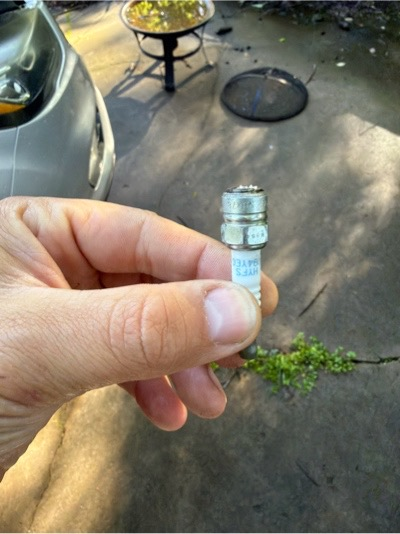
Well, to tell you the truth. Actually, let's take an example for one of our own recent online inquiries. One customer recently attempted a spark plug replacement after watching several instructional videos online. Everything was going well until the spark plug broke. (Picture shown is from the customer, not us.)And the location of the break is legit insane.
Now instead of replacing a spark plug, you're dealing with a broken piece of hardened steel stuck inside the cylinder head. At this point, the repair no longer involved a simple socket and ratchet. It requires specialized knowledge, experience, and tools to extract, retap, and ensure the removal of any foreign matter from the cylinder head.
Honestly, the real danger isn't even the broken plug itself anymore. The actual danger is debris in the cylinder. Metal shavings falling into the combustion chamber can damage to the pistons, valves, and cylinder walls.
So when you don't know exactly what you're doing and you're not careful, a simple maintenance item can escalate into engine or even car replacement territory.
The final cost?
Approximately two and a half times what the original repair would have cost had it been performed professionally from the beginning.
That $12 spark plug suddenly became a very expensive lesson.
And this isn't rare. A quick browse through automotive forums and Reddit communities will turn up countless stories from DIY enthusiasts who accidentally snapped spark plugs during removal and found themselves facing extraction procedures. One mechanic on Reddit summarized it perfectly: "Once you've broken off a spark plug, you'll know that things can really go south... in a snap."
That may be the most accurate automotive summation on the internet.
The Broken Bolt That Refused to Leave
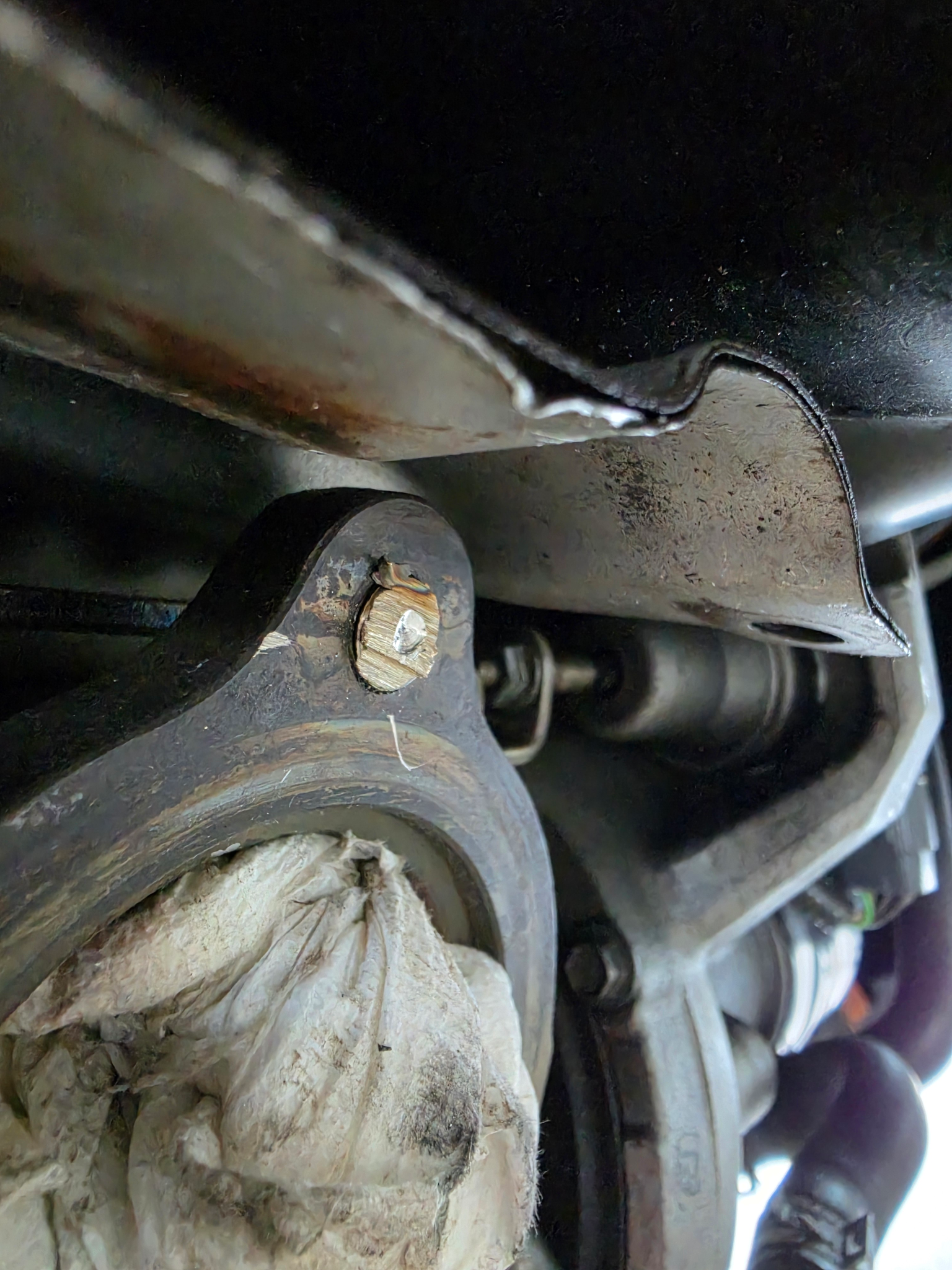
If broken spark plugs are the horror movie villains of DIY repair, then broken bolts are their evil twin. Many automotive repairs require removing bolts that have been exposed to years of heat cycles, corrosion, vibration, and road salt. Most of the time they come out without issue, but sometimes they don't. And when they don't you either end up with the easiest cast problem, a striped head. Or you might end up with the worst case scenario, sheared off and broken break. Like the picture shown here provided by a DIYer asking for help.
Where the bolt breaks off will provide varying levels of difficulty. In order of least to worst:
- Bolt breaks with plenty sticking out – This is the best-case scenario. A technician can often grab the remaining stud with locking pliers or a stud extractor and back it out without much drama.
- Bolt breaks flush with the surface – Now things become more difficult. Precision drilling, center punches, and extraction tools are usually required. Success depends on how seized the bolt is and whether it broke cleanly.
- Bolt breaks below the surface – At this point, there's nothing left to grab. The repair often requires careful drilling, specialized extractors, and sometimes thread repair if the original threads are damaged.
The location of the bolt won't matter so much to a shop in terms of cost to fix it, as they're all pretty much the same. However when they break on the backside of the engine by the firewall, inside an engine block, timing cover, cylinder head, or exhaust manifold, things get costly very quickly. Because in some severe cases removing the engine by crane is required for access.
What started as replacing your thermostat, or a sensor can suddenly require,
- Drilling precision holes
- Using extraction tools
- Re-threading damaged holes
- Installing thread repair inserts
- Potentially removing major engine components
That is how an "easy DIY repair" went from oops to crap. And what you hoped would cost parts only, has now turned into a few to several hundred dollars worth of labor.
The irony isn't lost here that the actual broken bolt may have cost than a fiver.
The Online Parts Trap
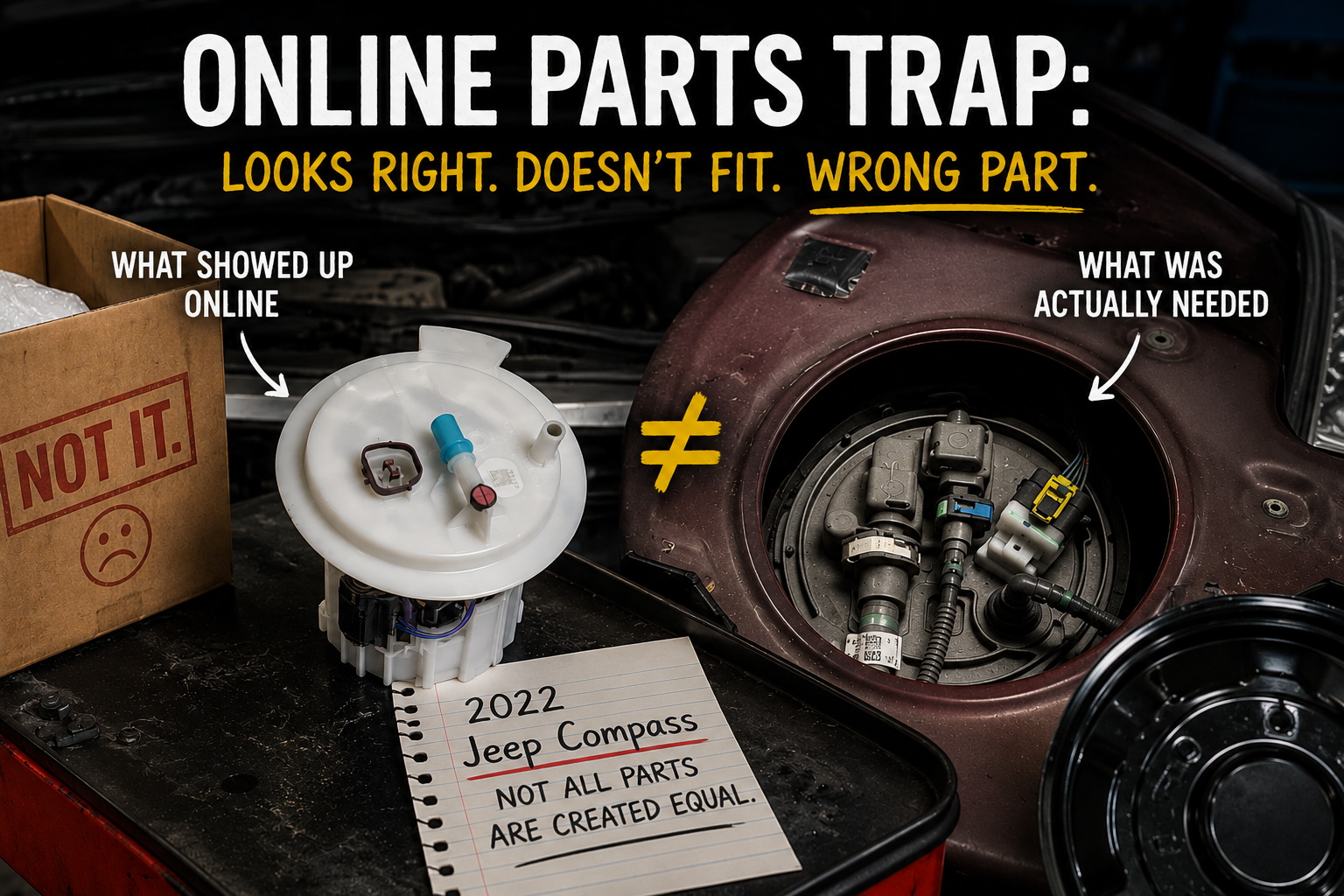
The internet has made new and used automotive parts more accessible than ever before. This is generally a good thing. Consumers can compare prices, research brands, and often save money. But modern vehicles have become incredibly complex, and manufacturers frequently make multiple variations of the same part. Remember when every phone manufacturer once had their own charging cord? Yup, it's like that. Many vehicle owners discover this the hard way when ordering parts.
Let's say you own a Ford Escape. Simple enough, right? You search for "Ford Escape alternator." You find one. You buy it. You wait a couple days, maybe a week. You go to install it. And then...It doesn't fit.
Why is that? Because your Ford Escape may have, multiple engine options, varying production dates, and trim package levels which require different electrical configurations. But yet, it's all under the same model name.
Professional repair facilities and mobile mechanics have resources that allow them to do VIN-based lookup systems and technical databases specifically because modern vehicles often contain numerous variations that aren't immediately obvious. Unfortunately, many DIYers discover this only after they've already disassembled half the engine compartment.
This is becoming more and more common place for Auto Monkey as people are looking for ways to reduce their repair costs. Just yesterday a mechanic ended up charging the customer an extra $600 to go get the correct fuel pump since they had ordered incorrectly. Roughly 1/3 of that price was the mechanic's time to drive there and back, the remaining 2/3 was for the part. Nobody wants to pay someone $120 to $225 per hour to be there delivery boy, yet that's what ultimately happens when you're led astray by the internet part store.
The Confidence Curve Downfall
There is a fascinating pattern we see repeating.
The Growth. Growth begins with basic understanding and strong critical thinking skills. These are the building blocks to being an accomplished professional. It terms of repairs, it may look something like this.
- The first DIY repair goes well. Maybe it's an air filter.
- Then an oil change. No leaks.
- Then brake pads. Car doesn't squeal or cash.
- Then Spark Plugs.
- Then Suspension.
- Then Spark Plugs.
- Then brake pads. Car doesn't squeal or cash.
- Then an oil change. No leaks.
The Downfall. This all begins with over confidence and taking on repairs well outside your comfort zone. Even professionals, when starting out must start as a "Lube Tech" and they are highly supervised. After a year or so they may graduate from Lube Tech to Apprentice to C-Level, B-Level, A-Level and finally Master Technician. The graduation is gradual and takes several years, hundreds of car repairs, and multiple certification tests to achieve Master Technician. The Downfall and spiral looks something along these lines and can quickly resemble something more like the quicksand effect.
- Mistake 1.
- Mistake 2.
- No Problem. "That's easy!" they exclaim, just like Brave, Brave Sir Robin Hood in Monty Python's The Holy Grail.
- Attempting to fix the mistakes by unconventional means.
- They are promptly cast into the Gorge of Eternal Peril.
- They try get out of the Gorge of Eternal Peril.
- They break more things in the process.
- They try get out of the Gorge of Eternal Peril.
- They are promptly cast into the Gorge of Eternal Peril.
- Attempting to fix the mistakes by unconventional means.
- No Problem. "That's easy!" they exclaim, just like Brave, Brave Sir Robin Hood in Monty Python's The Holy Grail.
- Mistake 2.
The challenge comes when simple maintenance evolves into repairs that require experience rather than just informational videos. It's really difficult to the Gorge of Eternal Peril, regardless of the climbing gear you buy.
Sure, certain YouTubers can show procedures. But they can't teach judgement. A video can show someone how to remove a bolt, but experience teaches when a bolt feels like it's about to break. A video can show how to install a spark plug, but experience teaches when the threads don't feel quite right and when tight is tight enough or not tight enough. A scan tool can identify a sensor code, but experience teaches when the sensor probably isn't the actual problem.
Experience is where professional technicians earn their value—even more than the certifications they may carry. Not because they know how to turn wrenches, but because they know when something is about to go wrong, and know when to stop.

So Should You DIY?
Absolutely. Learning basic vehicle maintenance is valuable to everyone who owns and drives a vehicle. The key is understanding where your knowledge ends and recognizing your limits. There is no shame in stopping a project halfway and calling for help. In fact, that decision can save thousands of dollars.
The smartest DIYers are not the ones who attempt everything and understand when they've reached the edge of their expertise.
In the event you do get stuck and need help, Auto Monkey is here for you. No Judgements. Just help.