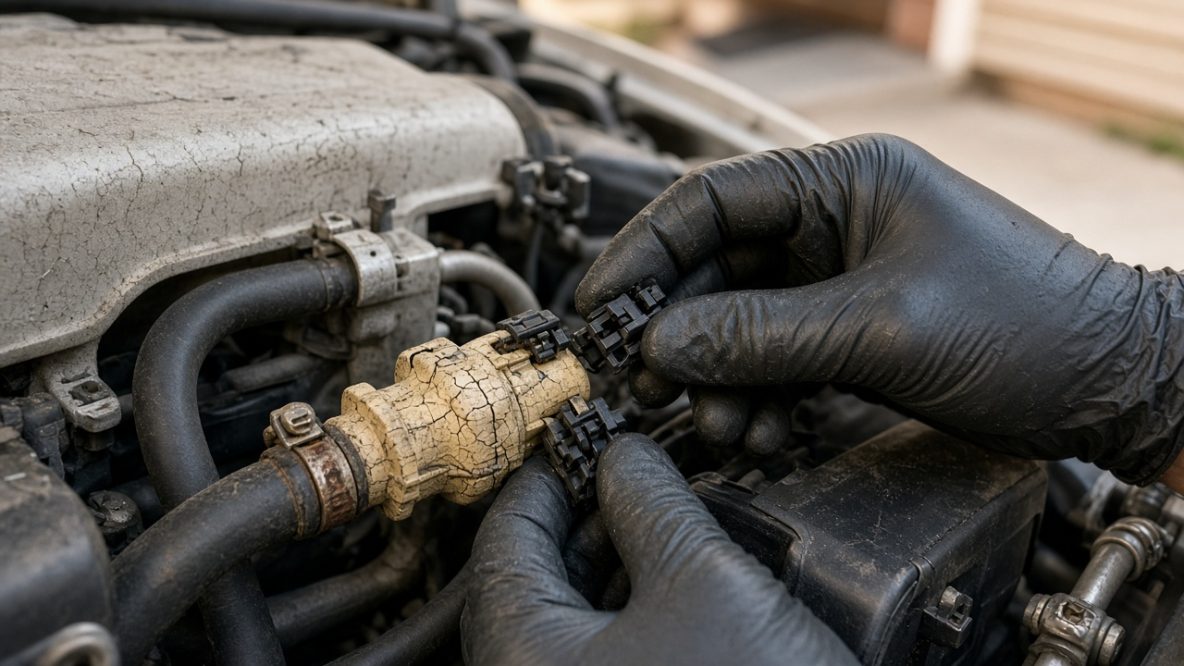
You booked a simple repair. Maybe a thermostat, a hose or a sensor. Then your phone buzzes and your mechanic says, “Heads up. While I was taking things apart, a plastic coolant fitting cracked.” Welcome to the world of brittle parts: old clips, connectors and coolant fittings that snap during otherwise routine service.
Cue the sinking feeling. You didn’t ask for a new part. The mechanic didn’t want to break one. So who pays for it?
It’s one of the most common, and most misunderstood, conversations in car repair. In this article, we’ll cover why older parts get brittle, why brittle parts so often give up during routine service, how professional shops decide who’s responsible, and exactly how Auto Monkey handles it when it happens in your driveway.
What Makes Car Parts Brittle?
Modern engines are full of plastic, composite and rubber. It’s lighter and cheaper than metal, and when it’s new it does the job well. The problem is that it lives under the hood, where it gets cooked and cooled hundreds of times a year.
Every heat cycle bakes a little more flexibility out of it. Add years of age, coolant, oil vapor, ozone, road salt and moisture, and parts that used to bend start to crack instead. Consumer Reports notes that heat, oil and ozone all attack the rubber compounds in hoses and belts, and that a hardened, glassy surface is a sign of heat damage. Metal has its own version of this: rust and corrosion that weld bolts and fittings in place.
The most common brittle parts include:
- Plastic clips, push pins and trim fasteners
- Electrical connectors and their locking tabs
- Coolant fittings, quick-connects and plastic radiator end tanks
- Vacuum lines, PCV hoses and air intake components
- Rubber hoses that have hardened from heat (see our guide, Is It Time To Replace Your Radiator Hoses?)
- Rusted bolts, studs and exhaust hardware
Why Brittle Parts Break During Routine Service
Here’s the frustrating part. A brittle part can keep working for years as long as nobody touches it. It’s sitting still, doing its job, slowly getting more fragile.
Then a repair comes along that requires the part to move. Clips have to flex to release. Connectors have to be squeezed and pulled. Hoses have to be twisted off their fittings. A part that was holding together only because it was left alone doesn’t survive the first bit of normal handling.
In many cases the part was already cracked, or right on the edge of failing. The repair didn’t create the weakness. It revealed it. That’s why an experienced mechanic can do everything correctly and still have a 15-year-old connector crumble in their hand. (Experience still matters, though. Knowing when a part is about to let go is a big part of what we covered in DIY Car Repairs: A Cautionary Tale.)
Who Pays When Brittle Parts Break?
There’s a fair way to look at this, and it’s how many professional shops spell it out in their terms:
- The shop is responsible for damage it causes. If a part breaks because a mechanic used the wrong tool, forced something, skipped a step or was careless, that’s on the shop, not you.
- The vehicle owner is responsible for parts that fail because of age, heat, corrosion or wear, when those parts couldn’t survive a normal, properly performed repair procedure.
There’s an important catch on both sides. “It was old” isn’t a free pass for sloppy work. Age alone doesn’t prove a part failed on its own, and a brittle parts policy should never excuse negligence. At the same time, a mechanic shouldn’t be expected to pay for a part that was already worn out before they ever opened the hood.
Think of it this way: the repair didn’t age the part. Time did. The mechanic’s job is to handle it correctly and tell you right away when it fails.
What a Good Shop Does When Something Snaps
How a shop handles the moment a part breaks tells you a lot about that shop. Here’s what good communication looks like:
- They stop and tell you. No surprise line items on the final bill.
- They show you. A photo or a look at the broken part, plus a plain explanation of what happened and why.
- They give you the cost before going further. A revised estimate for the replacement part and any added labor.
- They wait for your approval. You decide how to proceed.
- They write it down. The added work and your approval are documented, so nobody has to rely on memory later.
That lines up with long-standing consumer advice. The FTC’s Auto Repair Basics guide says a written estimate should state that the shop will contact you for approval before doing work beyond a specified amount, and the Texas Attorney General’s car repair tips recommend written authorization before any part of your car is disassembled. Good shops also set expectations up front. On older or high-mileage vehicles, a quick “some of these clips and fittings may not survive removal” before the job starts goes a long way.
How Auto Monkey Handles Brittle Parts
Auto Monkey works differently from most car repair companies. We don’t have a shop. Our mobile mechanics come to you, and the whole process runs through the Auto Monkey app. Here’s what that means when brittle parts break:
- It’s in our Terms and Conditions, in plain view. Plastic, composite and rubber engine and cooling system parts become fragile with age and temperature changes, and they can break or even disintegrate when they’re removed or handled. Auto Monkey isn’t liable for those age-related failures.
- You get a revised estimate. If one of those parts fails, you receive a revised estimate that includes replacing it, and you approve it before work continues.
- Nothing extra happens without your OK. Any work beyond the original work order requires an added-work request approved by both the mechanic and you.
- The pricing stays transparent. Estimates use flat-rate pricing based on industry-standard labor guides, with a full breakdown of labor, parts, fees and taxes.
- Experienced mechanics do the work. Most of the mobile mechanics on the Auto Monkey app are ASE-certified.
- Communication happens in the app. You and your mechanic stay in touch through the app, so the conversation and approvals are in one place.
- Support handles disputes. If you believe something broke because of how the work was done, contact Auto Monkey support. Disputes are handled by our support team, not negotiated between you and the mechanic.
Repairs are also covered by our 24-month or 24,000-mile warranty, whichever comes first, when Auto Monkey supplies the parts. You can read the details in our Auto Monkey FAQs and our Terms and Conditions.
Questions to Ask Before Your Next Repair
Whether you use Auto Monkey or any other shop, a few questions up front can save you a surprise later:
- “My car is older. Are there brittle parts on this job that commonly break during removal?”
- “If something breaks, will you stop and contact me before continuing?”
- “Will I get a revised estimate in writing before any added work?”
- “What does your warranty cover, and does it apply to parts I buy myself?”
- “Can I keep my old parts?” (Ask before the repair starts. Some parts carry a core charge.)
And one tip from the parts aisle: when a clip or fitting does break, replace it with a quality part instead of the cheapest option. We covered why in Using New Parts vs Old Parts. If a cracked hose or fitting turns into a bigger cooling system job, our mechanics also handle hose replacement and radiator repair.
The Bottom Line on Brittle Parts
Brittle parts aren’t anyone’s fault. They’re a normal part of owning a car that’s been around a while. What matters is how it’s handled: careful work, an honest heads-up, a clear revised estimate and your approval before anything else happens.
That’s how it works with Auto Monkey. Real mechanics. Same process. Same experience.
Need a repair on an older vehicle? Get an estimate in the Auto Monkey app and a mobile mechanic will come to you.